Eight Wins or Else: The Case Against Patience with Luke Fickell
$7.8 million per year. A 16-21 record. The easiest schedule in the Big Ten. The largest portal class in program history. A $2M+ quarterback. Every excuse has been systematically removed. The objective data tells the story.
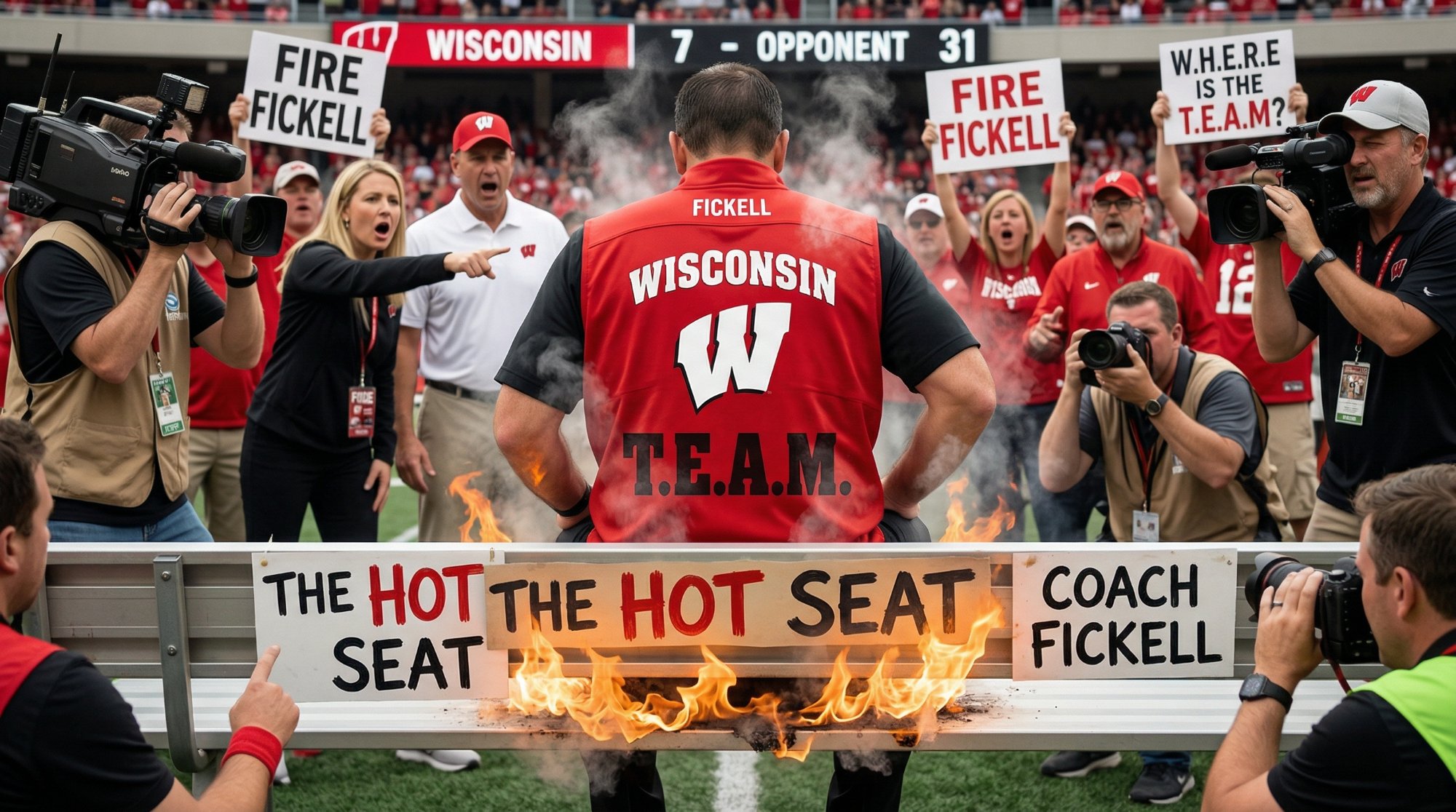
Wisconsin has spent three years, nearly $24 million in coaching salary, and immeasurable institutional goodwill on a football program that has gotten worse every single season under Luke Fickell. His record stands at 16-21 overall and 10-17 in Big Ten play — the worst three-year stretch in Madison since the pre-Alvarez dark ages. The program that Barry Alvarez built into a perennial 9-and-10-win machine has posted back-to-back losing seasons for the first time since 1991-92.
Now the university and the athletic department have bet tens of millions of additional dollars that 2026 will be different. The schedule is dramatically easier. The roster has been overhauled through the transfer portal. A premium transfer quarterback signed for north of $2 million. The coaching staff was rebuilt — again.
If all of that produces fewer than eight wins, the conclusion is inescapable: the problem is the head coach. And the $19.2 million buyout is cheaper than the alternative.
I want to be clear about what this piece is. This isn't a hot take. It's not an emotional reaction to 4-8. It's a data-driven argument built on objective facts — the contract economics, the schedule difficulty, the roster investment, the historical precedents, and the accountability chain that now runs from the athletic director's office to the head coach's chair. The numbers tell the story. Let's walk through them.
I. The $7.8 Million Man with a Sub-.500 Record
Luke Fickell earns $7,825,000 annually, making him the 21st-highest-paid coach in college football and roughly the 7th-highest-paid in the Big Ten. His original seven-year, $54.6 million contract, signed in November 2022, has been routinely extended through 2032. It includes a $100,000 annual escalator and up to $1.45 million in bonus potential — none of which he has triggered, because none of the bonus thresholds (Big Ten championship, CFP qualification) have been remotely approached.
The compensation-to-performance ratio is staggering. Among all coaches making $7 million or more in 2025, Fickell had the worst winning percentage at his current school. USA Today explicitly listed him among college football's "most overpaid" coaches. For context: Curt Cignetti at Indiana earns $8.3 million and has a 27-2 record over two years, including a national championship. Fickell earns comparable money and has produced consecutive losing seasons.
The Athletic Board's decision in February 2026 to decline a routine contract extension — the first time a returning Badger coach has been denied one — signals institutional awareness that this arrangement has an expiration date. Fickell himself requested that the extension not be put forward. That tells you something about the confidence level inside the building.
II. The Economics of Inaction
This is the part of the argument that should end the debate for anyone still clinging to patience. The buyout question isn't "can we afford to fire him?" It's "can we afford not to?"
The CROWE Report, published in October 2025 by UW-Madison's Center for Research on the Wisconsin Economy, quantified what fans already felt: declining football is an economic catastrophe for the state of Wisconsin. The report projected $280 million in annual statewide economic losses from continued football mediocrity — including $160 million to the Madison metro area and $20 million in direct athletic department revenue reductions.
Those aren't hypothetical projections. The erosion is already happening in real time. Season ticket sales dropped from 42,197 to 38,082 in a single year — a 10% decline. Secondary market prices for November home games fell below $10. The first home opener of 2025 drew the lowest attendance in over 30 years. Fan apathy isn't a future risk. It's the current reality.
Football generates roughly 80% of Wisconsin's athletic department revenue — $113.6 million in the most recent fiscal year, with a $72 million surplus funding every other sport. When football declines, everything declines. And the financial obligations are only growing: the House v. NCAA settlement adds an estimated $20.5 million in annual revenue-sharing costs starting in fiscal year 2026, while the department's proposed budget is a record $198.9 million.
Set the $19.2 million buyout against $280 million in projected annual statewide losses, and the math isn't close. The buyout is a one-time cost. The economic damage from continued mediocrity compounds every single year. For perspective: Indiana's turnaround under Cignetti saw football revenues quadruple, ticket revenue jump to $14.8 million, concession sales double, applications rise 12%, and enrollment hit a record 48,424 — according to Sportscasting's analysis of Cignetti's economic impact. Colorado under Deion Sanders saw athletic revenue surge from $117 million to $142 million in a single year, per On3's reporting on the program's financial filings. Winning football creates a financial flywheel. Losing football creates a death spiral.
At Wisconsin, the spiral is accelerating.
III. A Schedule Built for Eight Wins
The 2026 schedule represents a dramatic reduction in difficulty from 2025. Last year, Wisconsin faced the nation's No. 1-ranked strength of schedule per ESPN FPI, played seven ranked opponents, and met four eventual CFP participants (Ohio State, Oregon, Indiana, and Alabama). In 2026, Wisconsin avoids Ohio State, Oregon, Indiana, and Michigan entirely. Sports Illustrated confirmed that Wisconsin will face the easiest schedule in the Big Ten.
| Week | Opponent | Location | '25 Record | Category |
|---|---|---|---|---|
| 1 | Notre Dame | Lambeau (Neutral) | 14-2 | Tough Test |
| 2 | Western Illinois | Home | 4-8 (FCS) | Expected Win |
| 3 | Eastern Michigan | Home | 4-8 | Expected Win |
| 4 | at Penn State | Away | 13-3 | Tough Test |
| 5 | Michigan State | Home (HC) | 4-8 | Toss-Up |
| 6 | BYE | |||
| 7 | at UCLA | Away | 3-9 | Expected Win |
| 8 | USC | Home | 9-4 | Tough Test |
| 9 | at Iowa | Away | 9-4 | Toss-Up (Swing) |
| 10 | Rutgers | Home | 5-7 | Toss-Up |
| 11 | at Maryland | Away | 4-8 | Toss-Up |
| 12 | at Purdue | Away | 2-10 | Expected Win |
| 13 | Minnesota | Home | 8-5 | Toss-Up |
The Floor: Four Expected Wins. Western Illinois is an FCS team that went 4-8. Eastern Michigan went 4-8 in the MAC and ranked 126th nationally in SRS. UCLA went 3-9 last year, fired DeShaun Foster after 15 games, and hired Bob Chesney — who's making the leap from James Madison to the Big Ten for the first time. Purdue went 2-10 with a 0-9 Big Ten record for the second straight season and ranks dead last in the conference at 82nd in SP+. Wisconsin has beaten Purdue 18 consecutive times. If the Badgers can't go 4-0 in these games, nothing else in this article matters.
Five Toss-Ups. Michigan State (4-8, 1-8 Big Ten) fired Jonathan Smith after two seasons and hired Pat Fitzgerald; this is a Homecoming game at Camp Randall against a year-one rebuild. Rutgers (5-7) comes to Madison, where Wisconsin holds a 6-0 series lead. Maryland (4-8, 1-8 Big Ten) has gone 2-16 in conference play over two years. Minnesota (8-5 overall but 0-5 on the road in 2025) visits for the Paul Bunyan's Axe game. Iowa is the swing game — Kirk Ferentz's team went 9-4 last year but returns the least production of any team in the Big Ten. Fickell is 0-3 against Iowa and Kinnick is always hostile, but this is the most vulnerable Iowa roster in years.
Wisconsin needs to go 4-1 or 3-2 in these five games to reach eight wins. That's it.
Three Tough Tests. Notre Dame (14-2, projected top-5 nationally) at Lambeau Field is the hardest game on the schedule — Wisconsin hasn't beaten the Irish since 1963. Penn State is in transition under Matt Campbell, who arrived from Iowa State with 39 transfers, but the game is at Beaver Stadium against a program with a significant talent advantage. USC (9-4, SP+ No. 13) visits Camp Randall as the only projected preseason-ranked conference opponent.
Here's the key: Wisconsin can lose all three tough tests and still reach eight wins. The schedule is designed so that competent coaching should produce 8-4 or 9-3 with zero upsets. Stealing even one of the three tough games pushes the ceiling to 9 or 10 wins.
IV. The Roster Investment
Wisconsin attacked the 2026 transfer portal with unprecedented aggression, adding approximately 31 players — the largest portal class in program history, ranked 6th nationally by 247Sports. Six incoming transfers were consensus four-star recruits out of high school.
The headliner is quarterback Colton Joseph from Old Dominion, the Sun Belt Offensive Player of the Year who accounted for 34 total touchdowns and over 1,000 rushing yards. Reports indicate Wisconsin offered him an NIL package north of $2 million — the most lucrative deal the program has ever given a player. Major donor Ted Kellner framed the stakes publicly: "Are you going to give your QB two and a half million, three million? How you allocate those resources will become critical."
The staff was overhauled alongside the roster. Eric Mateos arrives from Arkansas, where he coached the No. 2-graded offensive line in the country. Ari Confesor comes from the Jacksonville Jaguars. Jayden Everett from Minnesota. Robert Steeples from Iowa State. Bob Ligashesky adds 40 years of experience as special teams coordinator.
This is an extraordinary concentration of new resources — and it raises an uncomfortable question that gets to the heart of the 8-win threshold.
V. The Staff Turnover Indictment
Wisconsin has employed four different offensive line coaches in four years under Fickell: Jack Bicknell Jr. (2023), AJ Blazek (2024-25), and now Eric Mateos (2026). For a program historically defined by its offensive line, this instability represents an identity crisis.
The wide receiver position has had a different coach every single year: Mike Brown (2023, left for Notre Dame), Kenny Guiton (2024, moved to QB coach), Jordan Reid (2025, left for the Atlanta Falcons), and now Ari Confesor (2026). The running backs coach changed when Devon Spalding departed for Michigan State.
Of the original 2023 offensive staff Fickell assembled — Phil Longo (OC), Jack Bicknell Jr. (OL), Mike Brown (WR), Devon Spalding (RB), and Nate Letton (TE) — only Letton remains in a comparable role. Every other offensive position coach has been replaced at least once, with the OL and WR positions turning over multiple times.
As Bucky's 5th Quarter noted this week, the constant coaching staff turnover may itself be the problem. The answer is that it's both a symptom and a compounding factor. The offense has been bad for three straight years — change was necessary. But the churn also means players are learning new systems and building new relationships on an annual basis. Four OL coaches in four years at a program defined by its offensive line is its own verdict.
The flip side: if these are finally the right guys, then there are no more excuses about needing time to "install the system." The system has been reinstalled every single year. One more installation shouldn't require patience.
VI. The 7-Win Trap
This is the section that matters most. The most dangerous outcome for Wisconsin in 2026 is not another 4-8 season — that would force an obvious decision. The dangerous outcome is 7-5: just good enough to claim "progress," just mediocre enough to guarantee continued decline.
Scott Frost, Nebraska. Went 4-8 in year one. Improved to 5-7 in year two. The "progress" narrative kept him employed through a 3-5 COVID season and a 3-9 year four. Nebraska restructured his contract rather than pay the buyout. He was fired three games into year five at 1-2, with a career record of 16-31. Total damage: five years, a $15 million buyout, and a program that required a complete restart.
Brent Pry, Virginia Tech. Went 3-9 in year one. Improved to 7-6 in year two — clear "progress." Was retained. Plateaued at 6-6 in year three. Fired after an 0-3 start to year four. Overall record: 16-24. The 7-6 season bought two additional years of mediocrity.
Billy Napier, Florida. Survived a 6-7 debut and a 5-7 second year because year three produced 8-5, framed as a "breakthrough." Fired four games into year four at 3-4. Overall: 22-23. Buyout: $21 million.
Mark Dantonio, Michigan State (late era). After a shocking 3-9 collapse in 2016, Dantonio rebounded to 10-3 in 2017. Then posted back-to-back 7-6 seasons as recruiting declined and he refused to overhaul his staff. He resigned in 2020, collecting a $4.3 million retention bonus and leaving the program in ruins. Michigan State has cycled through three coaches since.
The pattern is consistent: a bad year, a modest bounce, institutional patience justified by "trajectory," followed by plateau and eventual termination at greater cost. Seven wins is a trap. It's the natural reversion to a slightly less terrible mean against a much easier schedule, and it tells you nothing about whether the coach can actually build a program.
VII. The Counterexample
The argument for patience only works if there isn't a better alternative available. The transfer portal and NIL era have obliterated that premise. Programs no longer need three years to turn around. The right coach with the right resources can do it in one.
Indiana fired Tom Allen after years of patience with a historically moribund program. Curt Cignetti arrived, went 11-2 with a CFP berth in year one, then went 16-0 and won the national championship in year two.
Indiana isn't Wisconsin. Wisconsin has more resources, more tradition, more infrastructure, a better brand, and a larger fan base. If Cignetti could do that at Indiana, the right coach at Wisconsin should be able to do more. And here's where the recent NIL bill becomes relevant — not as a 2026 resource, but as a factor that makes the Wisconsin job significantly more attractive for a potential replacement. AB 1034's $14.6 million in annual state funding, combined with the existing revenue base and brand, means the next Wisconsin head coach would inherit one of the best-resourced jobs in the Big Ten. The pool of candidates willing to come to Madison just got deeper.
Every year spent on a coach who can't get the program to eight wins against the easiest schedule in the Big Ten is a year that a better coach could be building something.
VIII. The Accountability Chain
The people who made these decisions are on the record, and the record is specific.
AD Chris McIntosh told ESPN in November 2025: "Chancellor Mnookin and I are aligned on significantly elevating investment in our program to compete at the highest level." He added: "Our expectations are to compete at the highest level in the Big Ten and beyond."
The Athletic Board declined to extend Fickell's contract for the first time — a signal that the institution is watching.
Major donor Ted Kellner went public about the scale of NIL investment, saying the program expects to move from the "bottom third" to the "top third" of the Big Ten in financial resources.
The chain of accountability runs from the chancellor through the AD through the head coach. Every link in that chain has been publicly committed to an outcome. Eight wins isn't an arbitrary number. It's the minimum outcome that justifies the institutional risk and the political capital that was spent to make 2026 possible.
IX. The Line
FanDuel has set Wisconsin's 2026 over/under at 6.5 wins. Vegas expects six or seven wins. That's the market's baseline prediction — a schedule-adjusted projection based on roster talent and coaching track record.
Eight wins is one game above the market expectation. That single game represents the premium the university and the fan base are entitled to demand in exchange for: $7.8 million in annual coaching salary, the largest portal class in program history, a $2M+ quarterback, a fourth year of runway, and a schedule that was rated the easiest in the Big Ten.
The math requires winning four games you're supposed to win (Western Illinois, Eastern Michigan, UCLA, Purdue) and going 4-1 in the five toss-ups (Michigan State, Rutgers, Maryland, Minnesota, Iowa). You don't need to beat Notre Dame. You don't need to beat Penn State. You don't need to beat USC. You just need to handle business against inferior competition and split the coin-flip games.
That is the absolute floor of competent coaching given these circumstances. If Luke Fickell can't clear that bar in year four — with more resources than any Wisconsin coach has ever had, against the weakest schedule the program has faced in a decade — then the conversation isn't about patience anymore.
It's about whether someone else should be sitting in that $7.8 million chair, steering a program that the fan base, the donors, and the administration have all committed to returning to prominence.
Someone will deliver results at Wisconsin. The resources are there. The tradition is there. The fan base, despite everything, is still there — diminished, frustrated, but ready to come back if given a reason.
Eight wins. One game above the market. That's the line.
Wisconsin's NIL Bill Passed. Here's What It Actually Means. →
The full breakdown of AB 1034 and what it means for the long-term future of Badger athletics.
Sources & Attribution
- Fickell salary, contract, and buyout details — On3, WSAW
- USA Today "most overpaid" coaches list — Yahoo Sports / USA Today
- Athletic Board contract extension decision — Sports Illustrated, BadgerNotes
- CROWE Report economic impact projections — The Daily Cardinal, Athletic Business
- Season ticket sales decline (42,197 → 38,082) — Badger of Honor
- 2026 schedule rated easiest in Big Ten — Sports Illustrated
- 2025 schedule rated hardest in nation — Sports Illustrated
- 2026 transfer portal class (#6 nationally) — Yahoo Sports / 247Sports
- FanDuel 2026 win total (O/U 6.5) — BadgerNotes
- Staff turnover analysis — Bucky's 5th Quarter
- McIntosh ESPN quotes (Nov. 2025) — ESPN
- Indiana/Cignetti economic impact — Sportscasting
- Colorado revenue surge under Sanders — On3
- SP+ rankings — Yahoo Sports / ESPN
- Frost/Nebraska firing — CBS Sports
- Michigan State coaching carousel — FOX 2 Detroit
- Kellner donor quotes — BadgerNotes
- Opponent records and schedules — UW Athletics, Sports Reference