
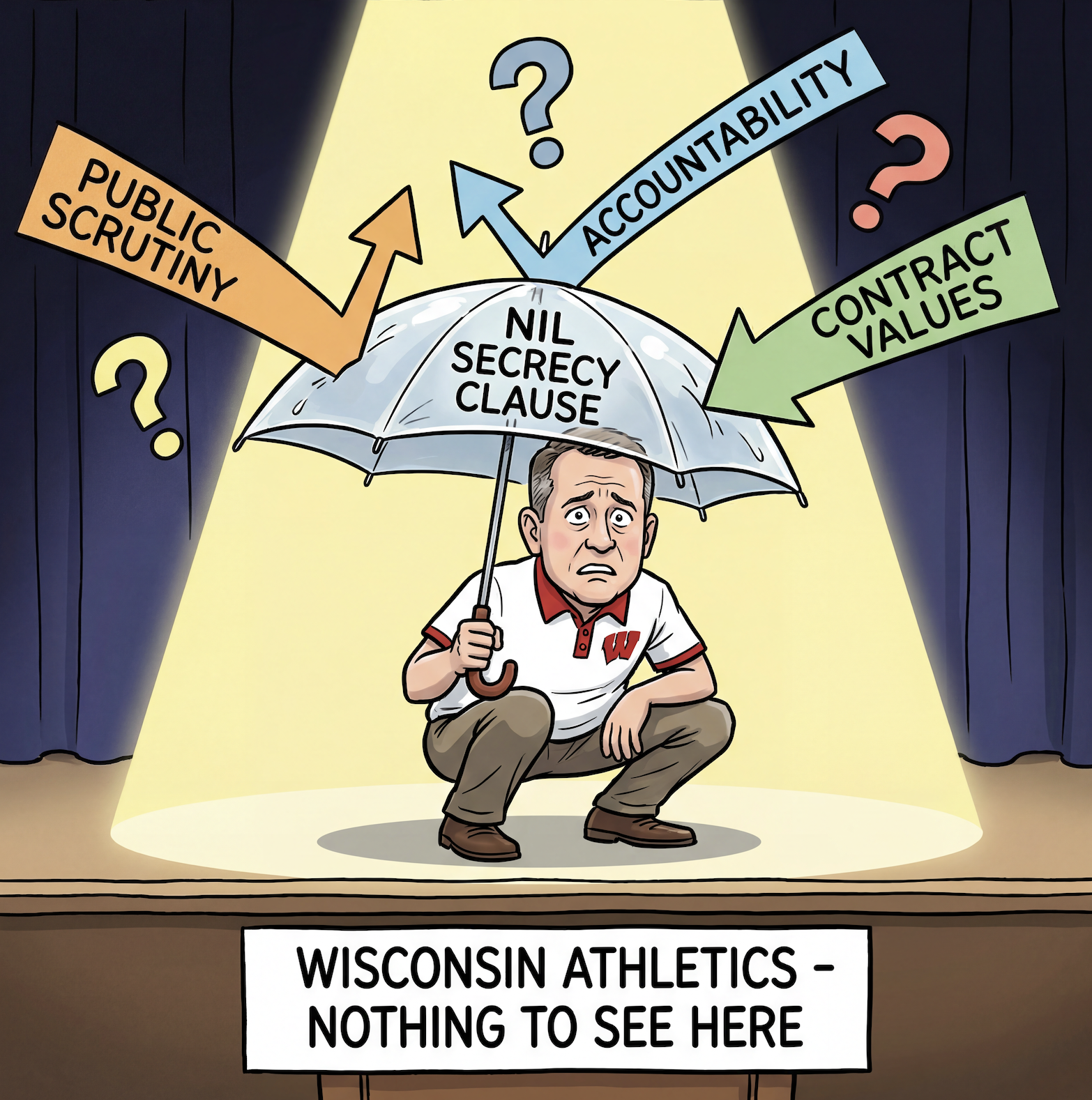
Governor Evers signed 2025 Assembly Bill 1034 on April 8 with a partial veto. This site has been loud in favor of the bill's funding mechanism — the $14.6M appropriation and what it unlocks for Wisconsin's ability to compete in the post-House era. I still am. But AB 1034 includes an open records exemption that goes well beyond protecting student-athlete NIL agreements. It is, in my read, indefensible on two independent grounds. Here they are.
The Wisconsin legislature was candid about what this bill does. The formal title of 2025 Assembly Bill 1034 reads, in full: "An Act relating to: name, image, and likeness rights for University of Wisconsin System student athletes; maintenance costs for University of Wisconsin–Madison intercollegiate athletic facilities; and making an appropriation." Those three pieces sit in the same sentence on purpose. The appropriation exists because the NIL rights exist. Chris McIntosh testified to the mechanism directly in committee — absorbing the facility debt frees up program revenue that can then flow into the rev-share pool to pay athletes.
Which means the taxpayer dollars are, in practical economic terms, funding the athlete compensation system.
When taxpayers fund an economic activity — any economic activity — they have a baseline right to see what's being done with their money. That principle is why nearly every public expenditure in Wisconsin is subject to open records requests in the first place. We get to see state employee salaries. We get to see vendor contracts. We get to see DOT bid awards. We get to see the compensation of every university chancellor, dean, and department chair on the state payroll. The default is disclosure, and the burden is on the government to justify exceptions.
AB 1034 inverts that default. It creates a self-asserted exemption where UW decides, under competitive-reasons language it defines itself, which records to withhold.
If the argument is that the state shouldn't be funding this, fine — that's a different debate. But if the state is funding it, the records should be open. You can't take the public's money and then tell the public it doesn't get to see how the money moves.
Here's where the NFL comparison matters, because it exposes how strange the UW position actually is.
NFL contracts are public record. Every dollar of every deal — base salary, signing bonus, guarantees, roster bonuses, escalators, void years, dead money — is visible to fans, media, and rival front offices within hours of signing. ESPN, The Athletic, Over the Cap, and Spotrac have built entire businesses around parsing cap implications. Sports talk radio is substantially a vehicle for second-guessing contract decisions. Fans debate whether the Packers overpaid for a left tackle on a Monday morning drive-time show using numbers that were in every contract-grading article by Sunday night.
The league that runs on this level of radical transparency — where every player's value is publicly debated in real time — happens to also be the most successful, most competitive, and most scrutinized professional sports league in the world. The disclosure has made front offices more disciplined, general managers more accountable, and the fan experience more engaged. When the Vikings sign a bad contract, everyone knows it's a bad contract the day it happens, and that public pressure forces organizational learning. GMs who consistently overpay get fired. The market corrects because the market can see itself.
Conversely, the incentive structures created by AB 1034's public records exemption are anti-competitive. Wisconsin taxpayers are going to be funding, through the rev-share mechanism the bill enables, a roster of college football players at costs approaching NFL rookie contract territory. Chris McIntosh, Marcus Sedberry, and Luke Fickell are going to be making allocation decisions about which positions to load, which transfers to chase, which retention offers to extend. Beyond football, McIntosh is going to be making strategic decisions about the size and shape of the rev-share pool, which sports get supported, which get cut. All those decisions are going to be consequential for the competitive outcomes the public is being asked to invest in.
And under the exemption, accountability is going to lag behind the data.
Nobody outside the athletic department will know whether the coaching staff paid $800K for a three-star defensive back and $200K for a four-star wide receiver. Nobody will know whether UW blew $1.2M on a transfer who never saw the field. Nobody will know whether internal allocation between football and the 22 non-revenue sports is reasonable or not. The people making the decisions will have every incentive to shield their mistakes and legal cover to do it.
The defense of the exemption is that disclosure would put Wisconsin at a competitive disadvantage. That's the same argument the NFL could have made in 1994, before salary-cap transparency became mandatory, and it's wrong for the same reason. Transparency creates league-wide discipline and generates more fan interest in the underlying product. The dynamism of the NFL contract market, where every dollar is visible and every decision is second-guessed in public, is a feature of the league, not a bug.
You can support AB 1034's funding mechanism and still say this exemption is bad law. In fact, if you take the funding mechanism seriously — if you believe, as this site does, that Wisconsin football is an economic asset worth protecting with public investment — then you should be the loudest voice demanding that the investment be fully accountable to the public making it.