
It's not fair, but math is math. Wisconsin's disproportionate investment into football this season is the correct call.
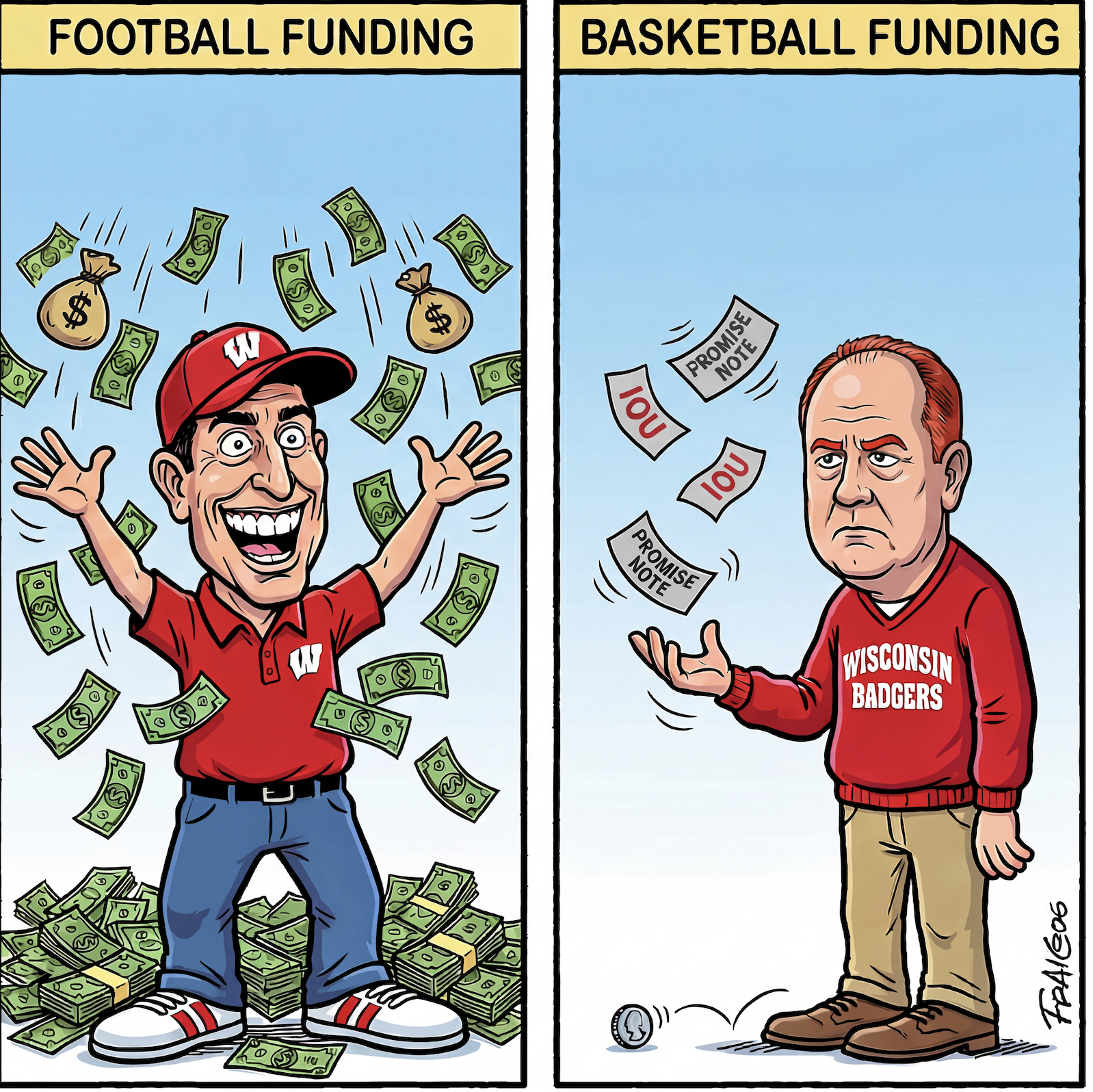
Wisconsin football generated $113.6 million in revenue against $41.5 million in expenses in fiscal year 2024-25. That is a $72 million contribution to the athletic department. Men's basketball, in the same year, generated $19.9 million against $12.4 million, for a $7.4 million contribution.
Football's profit, even when it's underperforming, is ten times basketball's profit. That single fact is the frame for every budget decision Wisconsin has made and will make, and it is the reason the athletic department's football-heavy 2026-27 allocation — the one basketball fans are right to notice — is the right call.
Money does not guarantee success in any given football season. Injuries, coaching hires, portal losses, bad bounces in close games — or just confirmation that the coaching wasn't good enough all along — any of those can sink a roster no matter what was spent on it, and the teams that win without the money exist in every era. But those teams are outliers. Over enough seasons, programs with more resources win more games, recover faster from down years, and dominate the top of the sport. The richest programs in the country are the ones that keep showing up in January.
What that means for Wisconsin is straightforward. You cannot control whether 2026 becomes one of the seasons that contributes to the aggregate or one that gets explained away by injury luck or a coach who couldn't do anything with the roster he was given. What you can control is how much you stack the odds in your favor before the season starts. And given where the two revenue programs actually sit — football spiraling into back-to-back losing seasons, basketball stable and operating above its pay grade, and football carrying ten times the financial weight of basketball in the department's books — probabilistically maximizing football's chances in 2026 is the decision the math demands. Not because the outcome is guaranteed, but because the cost of not trying is catastrophically larger than the cost of trying and missing.
The allocation for 2026-27 should be read accordingly. I'd be surprised if this is the permanent shape of how Wisconsin funds its sports. For now, it is a stabilization move, driven by the specific conditions of this specific cycle.
Football's contribution is enormous. It is also, at the moment, the line item most at risk.
Luke Fickell is 16-21 at Wisconsin, 10-17 in Big Ten play across three seasons. The 2024 season ended a 22-year bowl streak. The 2025 season went 4-8, fielded an offense that ranked 135th of 136 FBS teams in scoring at 12.8 points per game, and produced a six-game losing streak that included consecutive home shutouts against Iowa and Ohio State.
Camp Randall attendance collapsed in 2025. Scanner data pulled by Wisconsin State Journal's Todd Milewski via public records request, reported in Sports Illustrated, showed attendance down 20 percent year-over-year from 2024 to 2025. That is a cliff, not a slump, and it happened in a single season. The product is softening, and at Wisconsin, a ten percent swing in football contribution is seven million dollars — roughly the entire annual profit of the basketball program.
Basketball is the sport that keeps showing up, with or without the war chest. Greg Gard has produced eight NCAA tournament bids in ten opportunities (COVID cost the program a near-certain ninth in 2020), two Big Ten regular-season titles, two Coach of the Year awards, and a 27-10 team in 2024-25 that turned a single-year transfer into a consensus All-American.
Gard makes $3.85 million this season — which slipped into the bottom half of the Big Ten — with a contract amendment that loaded incentives into Sweet 16 and title-game milestones rather than base pay. The Kohl Center drew 15,006 a night last season in announced attendance, twelfth nationally and third in the Big Ten. The program loses its leading scorer to the portal and fans still show up for Indiana in December, because they show up for Indiana in December.
There's strong evidence that Gard can produce an economically viable product in spite of a bottom-feeder budget, and even if the team isn't good in a given year, the economic impact will be relatively marginal.
Wisconsin has two businesses sharing a cost base. One is big, profitable, and at risk of losing its emotional hold on its customers. The other is small, profitable, durable, and run by someone who has never required maximum resources to produce results. You stabilize the big one first. The math drives that call independent of which program you prefer to watch on a Saturday — the downside risk is asymmetrically larger on the football side, and the basketball side has repeatedly demonstrated it can absorb a lean cycle without breaking.
The 2026 window is the one you run the play in. You don't get the easiest schedule twice.
I suspect the concentration of spend into one year is the point. What Wisconsin does this year does not dictate how Wisconsin spends next year. For now, this is a stabilization move, and it will be reevaluated as soon as the results come in.
The calculus works because the downside cases are not symmetric. Basketball could get unlucky in 2026-27 — a key player gets hurt, a transfer doesn't pan out, or the moneyball formula that has kept the program above water just stops working because the talent isn't there this year. Even if all of that happens, the economic hit to the athletic department is measured in millions, not tens of millions. The program has the fan base, the coach, the arena floor, and the institutional track record to absorb a down year without the donor class flinching. Football does not have that cushion right now. Another 4-8 season at Camp Randall, especially after a year in which Wisconsin publicly committed to elevating the program, is the kind of event that repositions a donor base in a hurry.
None of this works if you ignore the guardrails.
Fickell has to respond to the investment. A 2026 team that goes 5-7 against the easiest schedule of the decade forces a coaching decision, and the Fickell buyout gets cheaper with every year that passes.
And basketball cannot be left to drift. It's important that the athletic department has at least one revenue-generating sport drawing positive attention to itself and to the university, and the goodwill that could be lost by letting the basketball program drift over time is hard to forecast from here — but it's real, and it compounds.
If you are a basketball fan reading this and feeling like the program is being asked to carry water for a football team that has not earned it — you are reading the situation correctly. Gard has been outperforming his budget. The Kohl Center still fills up. The portal keeps taking the program's best players and the program keeps making the tournament anyway. Watching all of that happen while the football team gets a resource injection after going 16-21 is frustrating in a way the financials don't entirely answer.
But the financials are the financials. Football is the business that funds the rest of the department, and it is also the business that is currently at risk. If football's revenue engine slips into a prolonged decline, the pressure on every other program in the department intensifies — basketball included. It is also possible the administration looks at the long arc and concludes that Wisconsin cannot afford to let basketball sink or swim at the mercy of football's success or failure. Having at least one revenue-generating sport drawing positive attention to the athletic department and the university is important, and the goodwill that could be lost by letting the basketball program drift over time is hard to forecast from here. Either outcome is possible. Both require football stabilizing first.
What Wisconsin basketball deserves next is more. More allocation, more NIL, more of the resources the program has demonstrated, year after year, it can turn into wins. That case gets stronger if football stabilizes. And regardless of what happens on the football field, it is a case that is going to have to be made sooner than later.
Wisconsin has made a bet. The bet is defensible. I hope it pays off.