Best in Wisconsin Stay in Wisconsin
Seven of the state's top ten recruits just committed to Wisconsin. The program's most important course correction in a generation is happening quietly — and the data says it might actually stick.
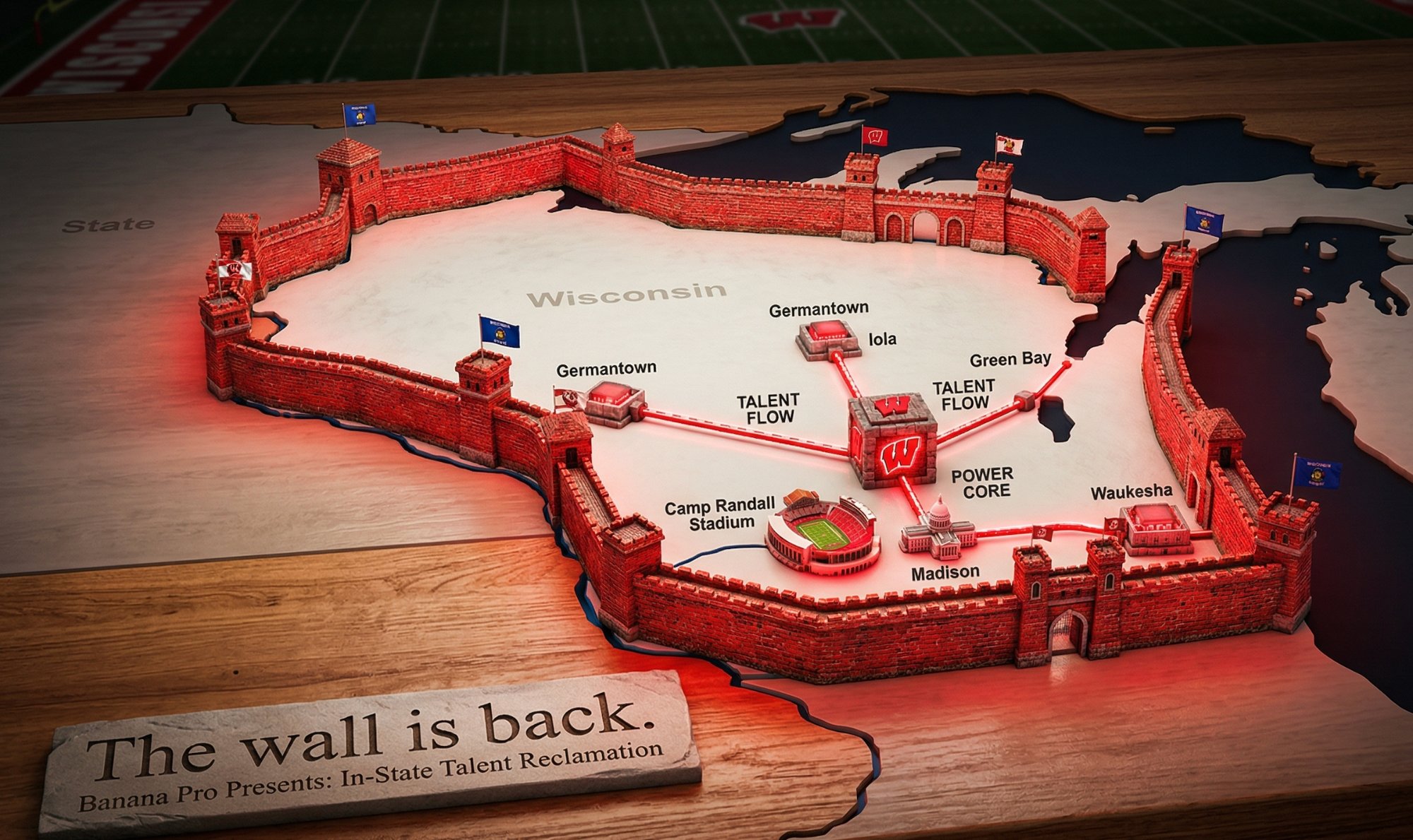
Wisconsin's 2026 high school recruiting class included one in-state scholarship player. One. Out of 13 signees. The class ranked 72nd nationally per 247Sports — the worst of Luke Fickell's tenure. Minnesota had signed four Wisconsin high schoolers. Indiana had two. The Badgers had Ben Wenzel from Appleton North, and that was it.
Meanwhile, the number of Wisconsin natives on the roster had dropped from 48 in 2021 to 35 in 2025, per the Daily Cardinal. The pipeline that produced Joe Thomas, Travis Frederick, Melvin Gordon, the entire Alvarez dynasty — the foundational competitive advantage of Wisconsin football for three decades — was disintegrating in real time.
So here's the question this piece is built around: what changed, why does it matter, and is there actual evidence that the 2027 recruiting class represents a structural correction rather than a temporary blip?
The answer, supported by the data, is yes. And the implications extend well beyond one recruiting cycle.
The Fence
Barry Alvarez arrived in Madison on January 2, 1990 and went 1-10 in his first season. His philosophy was simple and specific: lock down every viable football player in the state of Wisconsin before doing anything else. He later described the logic in characteristically blunt terms on ESPN Madison: "I'd have a summer camp, and you'd have 500 kids there, and 300 of them are linemen. I figured we could find some linemen consistently, and that's where you start in Wisconsin."
Dan Brunner, executive director of the Wisconsin Football Coaches Association, summarized the approach: Alvarez wanted to "build a fence around the state and lock up all the top Wisconsin high school recruits." He did. His first class included Brent Moss from Racine Park, who became the 1993 Rose Bowl MVP — four years after the 1-10 debut. Three Rose Bowl titles followed. The model became self-sustaining because in-state recruits who developed into NFL players created credibility with the next generation of Wisconsin high school coaches and families. Joe Thomas from Brookfield Central became a Hall of Famer. J.J. Watt left the state for Central Michigan before transferring to Wisconsin as a walk-on — and became a three-time Defensive Player of the Year. Even when someone slipped through the fence, the program's gravity pulled him back. His brother T.J. followed. Travis Frederick from Big Foot High School became a five-time Pro Bowl center. The list is absurdly long for a program that almost never cracked the top 25 in national recruiting rankings.
By 2017, Sports Illustrated reported that exactly half of Wisconsin's roster was homegrown, with 12 of 17 offensive linemen and 8 of 12 defensive linemen hailing from in-state. Of the 16 four- and five-star recruits raised in Wisconsin over the preceding decade, 13 enrolled at Madison — an 81% capture rate. Over the six prior NFL drafts, 14 of 21 Badgers selected were Wisconsin natives. The wall worked because Wisconsin is the only FBS program in the state. There's no in-state rival splitting the talent base. Every kid who grows up watching Badger football has one realistic path to play Power conference football close to home. When the program prioritizes those kids, it's playing a structural advantage that Ohio State, Alabama, and Georgia can replicate in their own states but cannot take away.
Paul Chryst maintained the pipeline. Bret Bielema took 42 in-state prospects in his final four classes and led three consecutive Rose Bowl trips. The model was proven, sustainable, and fundamentally sound.
Then it broke.
The Breach
When Fickell replaced Chryst's staff in late 2022, the critical in-state recruiting relationships walked out the door with the departing assistants. Joe Rudolph — a 1990s Badger lineman who'd spent years cultivating Wisconsin high school coaches — left for Notre Dame. And he didn't stop recruiting the state of Wisconsin when he got there.
The losses were specific and painful. Four-star offensive tackle Owen Strebig from Catholic Memorial — the state's top prospect in the 2025 class — chose Notre Dame, recruited in part by Rudolph. Four-star tight end James Flanigan from Green Bay Notre Dame Academy went to Notre Dame as a legacy. Four-star cornerback Tre Poteat from Verona picked Tennessee. Four-star lineman Nathan Roy from Mukwonago went to Minnesota. The state's top recruit in 2024, Garrett Sexton from Hartland Arrowhead, committed to Penn State — and Wisconsin hadn't offered him until late in the cycle after other targets had decommitted. That's worse than losing a recruiting battle. It means the kid wasn't a priority until it was too late.
Catholic Memorial alone — one high school program in Waukesha — sent Strebig, and later multiple teammates, to Power conference programs outside of Wisconsin over the span of two recruiting cycles. That's a single pipeline rupture that produced cascading losses.
The staff framed the small 2026 class as a deliberate strategic pivot. BadgerNotes reported Fickell's rationale: fewer high schoolers, more portal transfers, treating freshmen like "draft picks." It's a reasonable philosophy in the abstract — most elite programs have shifted toward portal-heavy roster construction. But the 2027 class has quietly exposed the argument. If the strategy was genuinely "recruit fewer high schoolers," why is the same staff now aggressively pursuing every top prospect in the state? The more honest interpretation is that the 2026 class was a failure the program is trying not to repeat, and 2027 represents the actual philosophical correction. The staff knows it. The results confirm it.
Seven of Ten
Wisconsin's 2027 recruiting class, as of April 1, 2026, includes seven commitments. All seven are from the state of Wisconsin. They represent seven of the state's top ten prospects per 247Sports Composite. The class ranks 14th nationally and 5th in the Big Ten.
Here's who's in:
Korz Loken — four-star tight end from Iola-Scandinavia (State #2, 247 Composite 90). Committed at the Navy All-American Bowl in January, choosing Wisconsin over Notre Dame, Penn State, and Indiana. Immediately became the class's most vocal recruiter, posting "Best in Wisconsin stay in Wisconsin" on social media and organizing a peer-recruiting campaign targeting remaining in-state prospects.
Cole Reiter — four-star offensive tackle from Germantown (State #3, 247 Composite 90, 6-7/315). Chose Wisconsin over Michigan, Ohio State, and Penn State. After committing, he told 247Sports: "Being a part of the big class of in-state commits — I don't know how long it's been since Wisconsin had this many in-state kids commit. I think that is awesome."
Hunter Mallinger — four-star interior offensive lineman (per Rivals) from Hamilton in Sussex (State #4, 6-6/290). Committed on April 1 alongside his twin brother. Yes — twin offensive linemen named Mallinger committed to Wisconsin. The name alone belongs on the Camp Randall offensive line depth chart.
Isaac Miller — three-star edge from Catholic Memorial in Waukesha (State #7, 6-5/250). Chose Wisconsin over Florida, Michigan, Miami, Ohio State, and Notre Dame. The significance: Catholic Memorial is the same program that sent Owen Strebig to Notre Dame two years ago. Miller staying home signals that the relationship between Wisconsin and one of the state's most important high school programs is being repaired.
Dustin Roach — three-star safety from Catholic Memorial in Waukesha (State #8, 6-3/180). Miller's teammate. Two Catholic Memorial kids choosing Wisconsin in the same class, after the program had become a pipeline to South Bend, is a data point that speaks louder than any press conference.
Ethan McIntosh — three-star offensive tackle from Verona (State #9, 6-7/250). The first commit in the class and the son of athletic director Chris McIntosh. Was the class's first commitment and has been actively recruiting other in-state targets, including posting "Missing Piece" graphics on social media targeting the Mallinger twins.
Reece Mallinger — three-star interior offensive lineman from Hamilton in Sussex (State #10, 6-6/285). Hunter's twin. Committed April 1. "Badger Nation, we're home!!" the brothers told Hayes Fawcett of On3/Rivals.
The eighth name on the board — though not yet committed — is Kingston Allen from Green Bay Notre Dame Academy (State #1, four-star running back, 247 Composite 90). Allen set the WIAA single-season record with 3,436 rushing yards and 57 touchdowns as a junior, won Gatorade Wisconsin Player of the Year, and carries a 100% crystal ball projection to Wisconsin on 247Sports. He hasn't committed. But every public signal points to Madison.
The two top-ten recruits who went elsewhere: #5 committed to Notre Dame (family legacy — his father and brother attended Notre Dame), and #6 committed to Northwestern. Neither represents a recruiting failure in any meaningful sense.
Why This Matters More Than the 2026 Season
The natural instinct is to treat recruiting classes as secondary to on-field results. But the evidence — from Wisconsin's own history, from Iowa's model, and from every elite program in the country — says the opposite. Programs that dominate their home state build floors that losing seasons can't destroy. Programs that abandon their home state lose the structural advantage that makes sustained success possible.
The Iowa comparison is instructive and, for Wisconsin fans, uncomfortable. Kirk Ferentz has posted eight or more wins in every full season since 2015. He surpassed Woody Hayes as the Big Ten's all-time winningest coach in September 2025 with his 206th victory. Iowa's population is barely half of Wisconsin's, and Ferentz has to compete with Iowa State for in-state talent — a rival Wisconsin doesn't have. In 2025, Iowa outscored Wisconsin, Minnesota, and Nebraska in their three trophy games by a combined 118-19. Ferentz has done all of this without ever recruiting a top-ten national class. He's done it by identifying, recruiting, developing, and retaining Iowa kids — then supplementing with targeted out-of-state additions at specific positions.
That model produced Tyler Linderbaum (Solon, Iowa — Rimington Award winner, first-round pick), Brandon Scherff (Denison, Iowa — fifth overall pick), and Tristan Wirfs (Mount Vernon, Iowa — 13th overall pick). Three in-state offensive linemen. Three first-round NFL draft picks. Sound familiar?
Nationally, the data is equally clear. Nick Saban signed Alabama's number one in-state recruit in 12 of his 15 full recruiting classes. Kirby Smart signed a program-record 22 players from the state of Georgia in 2025. A 33rd Team study tracking which programs sign the most top-15 in-state recruits over a decade found that the top ten teams in this metric averaged almost nine wins per season. Bud Elliott, one of the most respected national recruiting analysts, summarized the principle: "If you're going to be a good recruiting school, you've got to own your own backyard, then cherry pick from other areas."
Wisconsin doesn't need to out-recruit Ohio State nationally. It never did. Alvarez proved you could win Rose Bowls by capturing 80% of the state's four-star talent and developing three-star linemen into NFL players. The program's competitive advantage is structural: the only FBS school in a state that disproportionately produces offensive and defensive linemen and tight ends — exactly the positions the Wisconsin identity is built around. When the program exercises that advantage, it wins eight-plus games consistently. When it doesn't, you get 4-8.
Why It Might Actually Stick
Recruiting classes are verbal commitments from 16- and 17-year-olds. They can decommit. A bad 2026 season could shake the foundation. Every honest assessment of this class has to acknowledge the fragility.
But there are structural reasons to believe this cycle is different from a temporary blip. The first is that the recruits themselves have become the primary recruiters. Sports Illustrated reported that Loken, McIntosh, and Miller organized a social media campaign called "The Missing Piece," posting graphics showing committed in-state players as puzzle pieces with open spaces targeting remaining prospects. McIntosh posted a graphic targeting the Mallinger twins. Miller recruited across the Minnesota border. This is organic, player-driven momentum — not a staff initiative. It's harder to manufacture and harder to fake.
The second is institutional investment. The NIL bill (AB 1034) injected $14.6 million in state funds into Wisconsin athletics. Mega-donor Ted Kellner publicly committed to moving Wisconsin's financial resources from the bottom third to the top third of the Big Ten. Athletic director Chris McIntosh published a public letter pledging increased investment in recruiting and retention. These are structural changes that outlast any single recruiting cycle.
The third is coaching staff changes that directly affect in-state relationships. New offensive line coach Eric Mateos visited the Mallinger twins at Hamilton High School within days of being hired, per Sports Illustrated. That kind of immediate in-state engagement signals a prioritization that was absent from earlier Fickell staffs.
And the fourth is the composition of the class itself. Four offensive linemen and a tight end. This is the most Wisconsin recruiting class in years — built on the positions the state produces naturally and the program has historically developed into NFL players. It's not a coincidence that the class that looks most like a Barry Alvarez class is also the one generating the most in-state momentum.
The Line Between Optimism and Proof
Nothing in this piece should be read as a declaration that the program is "back." That word gets earned on Saturdays in September, October, and November. The 8-win threshold laid out elsewhere on this site still applies. The on-field product in 2026 will determine whether these recruits ultimately sign, and whether the next cycle sustains the momentum or collapses under the weight of another losing season.
But recruiting is a leading indicator. Wins and losses are lagging. And the leading indicators, right now, are pointing in a direction they haven't pointed in years. Seven of the state's top ten. A class ranked 14th nationally. Twin offensive linemen from Sussex named Mallinger. A peer-recruiting culture built on a mantra — "Best in Wisconsin stay in Wisconsin" — that didn't come from a marketing department. It came from a tight end in Iola.
Barry Alvarez, speaking on ESPN Madison in November 2024, was asked about the program's identity. His answer: "I can't answer that. I'd like to see it myself. When I took the job, I looked at the type of players that we could consistently recruit, and you look around the state... That was the mantra of our whole program. I'm crying to see the same thing, crying to see the physicality."
The physicality isn't back yet. The wins aren't back yet. But the fence? For the first time in three years, someone is actually rebuilding it.
Eight Wins or Else: The Case Against Patience with Luke Fickell →
The complete data-driven argument behind the 8-win threshold for 2026.
Wisconsin's NIL Bill Passed. Here's What It Actually Means. →
The full breakdown of AB 1034 and what $14.6M in state funding means for the program.
Sources & Attribution
- In-state roster count decline (48 to 35) — The Daily Cardinal
- 2026 class ranking (72nd nationally, 1 in-state scholarship player) — 247Sports
- 2027 class commitments and rankings — 247Sports Composite
- "The Wall Around Wisconsin" (in-state roster composition, capture rates) — Sports Illustrated (2017)
- Kingston Allen WIAA records (3,436 yards, 57 TDs) — WBAY, MaxPreps
- Cole Reiter commitment quote — 247Sports
- Mallinger twins commitment — Yahoo Sports / On3
- "The Missing Piece" social media campaign — Sports Illustrated
- Eric Mateos visiting Mallinger twins at Hamilton HS — Sports Illustrated
- Fickell 2026 class philosophy ("intentional") — BadgerNotes
- Barry Alvarez ESPN Madison quotes (November 2024) — Badger of Honor / ESPN Madison
- Kirk Ferentz surpasses Woody Hayes (206 wins) — CBS Sports
- Iowa 2025 trophy game scores (118-19) — ESPN Box Scores
- Owen Strebig to Notre Dame — BadgerExtra
- Minnesota signing Wisconsin high schoolers in 2026 — Sports Illustrated
- 33rd Team in-state recruiting study — The 33rd Team